Abstracts
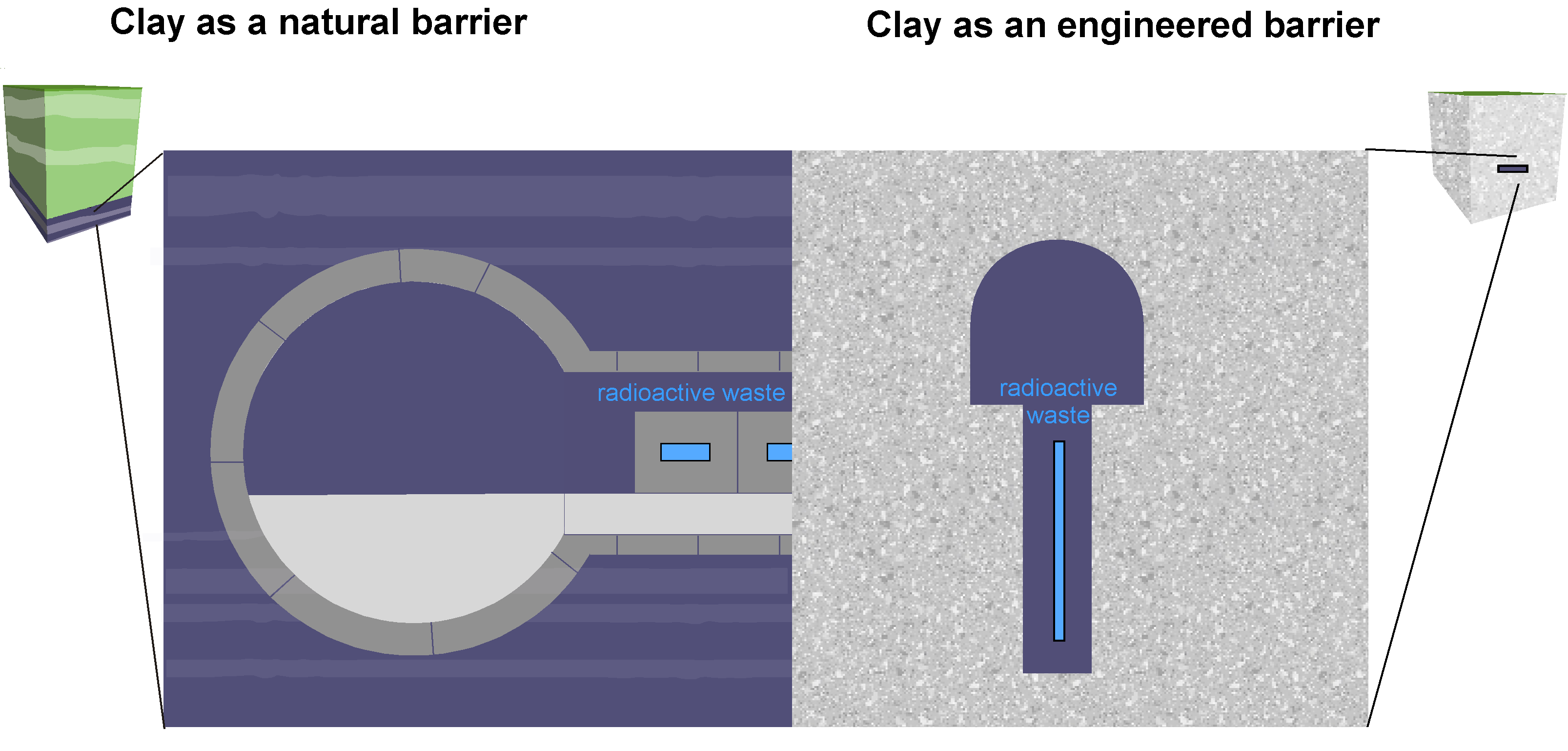
At this 10th International Conference on Clays in Natural and Engineered Barriers for Radioactive Waste Confinement, we are particularly interested in the use of clay barriers for geological disposal of radioactive waste. Clay rocks are being considered in a number of countries as potential host rocks. Swelling clays are considered as engineered barriers in a wide variety of host rocks. A series of natural and engineered barriers act in concert in a multibarrier system to isolate the radioactive waste and contain the radionuclides in the long term. In order to increase confidence in the long-term safety provided by the multibarrier system, multidisciplinary approaches are required in order to provide a detailed characterization of the clay barriers and their confinement properties, but also to assess the behaviour of engineered and natural barriers over time. A great emphasis is put on implementation-oriented topics in order to reflect the progress made in geological disposal projects across Europe. Each used technique for construction, operation, and closure of this facility can have an impact in the evolution of the clay barrier(s) in each multibarrier system in the long term. The use of Artificial Intelligence and machine learning is getting a prominent place in several scientific and technical developments. We encourage the submission of abstracts that would make use of these techniques in any of the proposed topics, but we do not devote a dedicated topic to this.
1. Design, construction and optimization
Design specifications of optimized technologies and materials for excavation including construction-induced fractures, design requirements for the support in a facility in clay rock and post-closure phase,
Building Information Model (BIM) in which (perturbed) clay rock properties are included. Incorporation of emerging Best Available Technologies (BAT) including environmental impact.
2. Manufacturing, installation and optimization
Design specifications of optimized technologies and materials for manufacturing engineered clay barriers for sealing and backfilling, design requirements for the operational and post-closure phase.
Incorporation of emerging Best Available Technologies (BAT) including environmental impact. Methods and requirements for the installation of engineered clay barriers e.g. to prevent piping erosion in the post-closure
evolution. Potential sources for the supply of qualitative good clay material including environmental impact and characterisation methodologies.
3. Monitoring
Sensor technologies that could measure properties in the clay rock and swelling engineered clay in order to follow these clay properties in the constructional and operational phase of the geological disposal facility.
Clay behaviour deduced from measuring properties of other engineered materials are also included. Data management and high-performance data analytics to optimally use the obtained monitoring data.
4. Geochemistry and radionuclide migration
Mineralogy and other solid phases (organic matter, phosphate), solid-water interactions, pore-water chemistry, and geochemical modelling. Migration of radionuclides and chemo-toxic substances through a clay host
rock and swelling engineered clay.
5. Evolution with perturbations in the clay host rock
Post-closure evolution of the clay rock in the near-field including potential interactions with engineered materials: thermal, hydro-mechanical (water and gas transport processes), chemical (solute processes),
and biological processes. The impact of the processes on the functions of the clay rock should be highlighted.
6. Evolution with alterations in engineered clay
Post-closure evolution of the swelling engineered clay including potential interactions with a host rock and other engineered materials: thermal, hydro-mechanical (water and gas transport processes),
chemical (solute processes), and biological processes. The impact of the processes on the functions of the engineered clay should be highlighted.
7. Geology and hydrogeology
Site characterization (boreholes, seismic, geophysics, URLs) sedimentology, diagenesis, dating techniques, discontinuities in clay rocks, isotopes, and hydrogeology modelling in a performance assessment for the far-field.
8. Safety case and licensing
The role that the safety case takes throughout the conceptual, site selection, constructional, operational, closure, and post-closure phases is different. Not-site specific safety cases are not for licensing but
can serve an important role in a country. A general licence of the site may be provided on the review of the site specific safety case by the licensing body. Licensing of the construction and/or operation of the
geological disposal facility based on the review of the safety case by the licensing body has taken place in Europe considering the progress made in geological disposal projects.